Leather or Fabric Upholstery: Durability, Ageing and Care
Leather and fabric both upholster a room well, but they age, wear and clean in very different ways. The right choice depends on how the seat is used, who uses it and how much change you are prepared to live with.
Choosing between leather and fabric is often framed as a question of looks, but the more useful question is how each will behave over years of use. A sofa or armchair is handled every day, sat on for hours, leaned against, sometimes spilled on and sometimes crossed with a pet's claws. Leather and fabric both meet these demands in different ways, and each develops its own character as it ages. Understanding those differences makes the decision far easier, and avoids disappointment once the piece is in the room.
This guide compares the two as we consider them when designing custom upholstered furniture, covering durability, ageing, comfort, cleaning and the questions to ask before ordering.
Start with how the seat will be used
Before comparing materials, be specific about the seat. Is it a family sofa that is used daily, or a reading chair used by one person in the evenings? Will children, pets, guests or a combination of them sit on it? Is the room sunny, and does the seat sit near a window? Do you want the upholstery to look better with age, or to look as it did on the first day? These answers matter more than any general rule, because they decide how much wear the material must resist and how much change you will accept.
Leather: character that develops with use
Leather is a natural material, and its surface carries the marks of the animal's life, which is part of its appeal. Leather is typically divided into finishes: aniline and semi-aniline leathers are dyed through and keep much of the natural surface, so they feel soft and show the grain and variation clearly. Pigmented or protected leathers have a surface coating that makes them more uniform in colour and more resistant to staining and fading, but they feel less like skin and show less of the character of the hide. Ask which type is proposed, because the same name can describe quite different products.
Leather develops a patina with use. Its surface softens, creases settle around the seat and arms, and the colour deepens or lightens depending on the dye and the amount of light it receives. Many people value this, but it is not uniform across a piece, and it is worth looking at samples in your room before deciding. Direct sunlight can fade leather unevenly, and sharp objects, pet claws and rough denim can mark or scratch the surface. Scratches on aniline leathers are often visible, whereas pigmented leathers hide them better.
Fabric: a wider range of feel and pattern
Upholstery fabrics are woven or knitted from natural fibres, such as linen, cotton, wool and silk, or from synthetic and blended yarns. Each has a distinct feel: linen is crisp and breathable, wool is resilient and warm, velvet is soft and deep, and performance blends are engineered for wear. Fabric is available in a far wider range of colours, textures and patterns than leather, which makes it easier to bring a seat into a particular scheme and to change it later through slipcovers or fresh upholstery.
Fabric ages differently. It can pill, crush at the seat, fade in strong light and show wear at the arms and seat edge. Linen creases and softens, and velvet can flatten where people sit. Good fabric is tested for abrasion, usually given as a rub-test rating, which shows how well it resists wear under a standard abrasive action. Ask for this figure, along with the colour fastness and the recommended use, since a fabric that drapes beautifully may not be suitable for a heavily used seat.
Durability in practice
Leather is generally tough and resists tearing, and it wipes clean easily, which makes it a practical choice for households with pets or children. Its main weaknesses are scratching, fading and sensitivity to heat and dryness. Fabric is more vulnerable to abrasion, staining and pilling, but a well-chosen performance fabric can outlast a poor leather. The durability of either depends on the grade of the material, the construction underneath, and the care it receives, so a good frame and well-made cushions are as important as the covering.
- Pets and claws: pigmented leather or a tightly woven performance fabric usually fares better than a soft, open weave.
- Children and spills: an easily wiped leather or a fabric with a suitable cleaning code helps, and removable covers are useful.
- Strong sun: choose a colour that resists fading, and consider blinds or film on the windows.
- Heavy use: check the rub-test rating, and prefer a construction designed for daily sitting.
- Cool, dry air: leather can dry and crack in very low humidity, so keep it away from heating vents.
Comfort and temperature
Leather can feel cool to the touch when first sat upon, and it warms as the body heats it. Some people find it less comfortable in hot weather, because it does not breathe as fabric does. Fabric is generally softer and more breathable, though some textured or high-pile fabrics can feel rough. Comfort depends as much on the cushion filling, the seat depth and the frame, so test a sample of the complete seat, not just the covering, before choosing.
Cleaning and care
Leather is usually cleaned with a soft, damp cloth and a cleaner made for the specific leather, and it should be conditioned as the maker advises to keep it supple. Harsh solvents and abrasive cleaners can damage the finish. Fabric is cleaned according to its care code, which tells you whether it can be treated with water, a water-based cleaner, a solvent-based cleaner, or only by a professional. Always test any cleaner on a hidden area first, and keep the care information with the piece. Spills should be blotted quickly rather than rubbed, whichever material you choose.
- Leather: wipe with a damp cloth and a suitable cleaner, and condition as recommended.
- Fabric: follow the care code, test cleaners on a hidden area, and blot spills at once.
- Both: vacuum regularly to remove grit, which wears surfaces faster than dust does.
- Both: rotate and plump cushions to keep the shape and spread wear evenly.
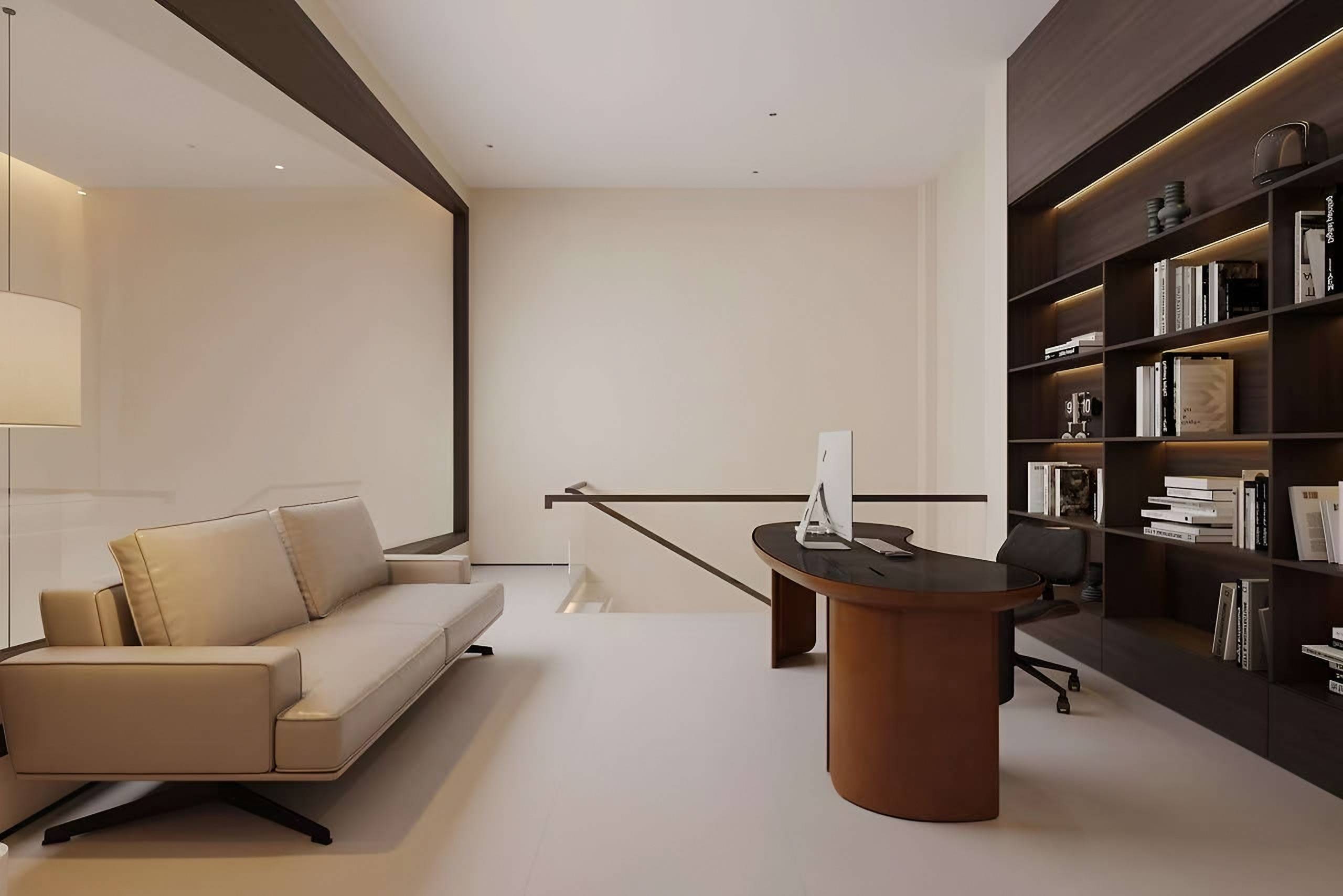
In the Ivory Apartment, a leather sofa sits in a study beside a curved timber desk and dark timber shelving. It is a useful reference for pairing leather with timber in a working room.
Choosing between them
Leather suits seats that will age visibly and that are used in a relaxed, lived-in way. It works well with timber, stone and warm neutrals, and in rooms where the character of the material is part of the design. Fabric suits seats that need a particular colour, pattern or softness, or that will be changed over time. Performance fabrics are a practical choice for busy households. Neither is inherently better: the right material is the one whose behaviour you will be comfortable living with.
Testing samples before you order
Samples show more than a screen can. Take several samples home and view them in daylight and in the evening, next to the other materials in the room. For fabric, rub a sample with a white cloth to check for colour transfer, and look at it under the lamps you use at night. For leather, check how the surface responds to a damp cloth, and look for natural variation you can accept. Ask for the full specification in writing, including the rub-test rating, the care code, the leather type and the expected maintenance.
- Decided how the seat will be used, and by whom.
- Compared leather types, or fabric durability ratings, not just the colour.
- Tested full-size samples in daylight and in the evening, beside the room's other materials.
- Checked the care instructions and the cleaning method for the material.
- Agreed the maintenance schedule, and kept the care information with the piece.
Choosing upholstery is one of the most important decisions in a living room. If you are planning a seat, start a project with a note of how it will be used and the room's light. We can help you compare the materials in your own space, and design the seat around the material you choose.
Continue reading
Tell us about your space.
Share your floor plan, room photographs and what you hope to create.