How to Furnish an Entire Home
Furnishing a whole home is a large undertaking. Done in the right order, it becomes a series of clear decisions.
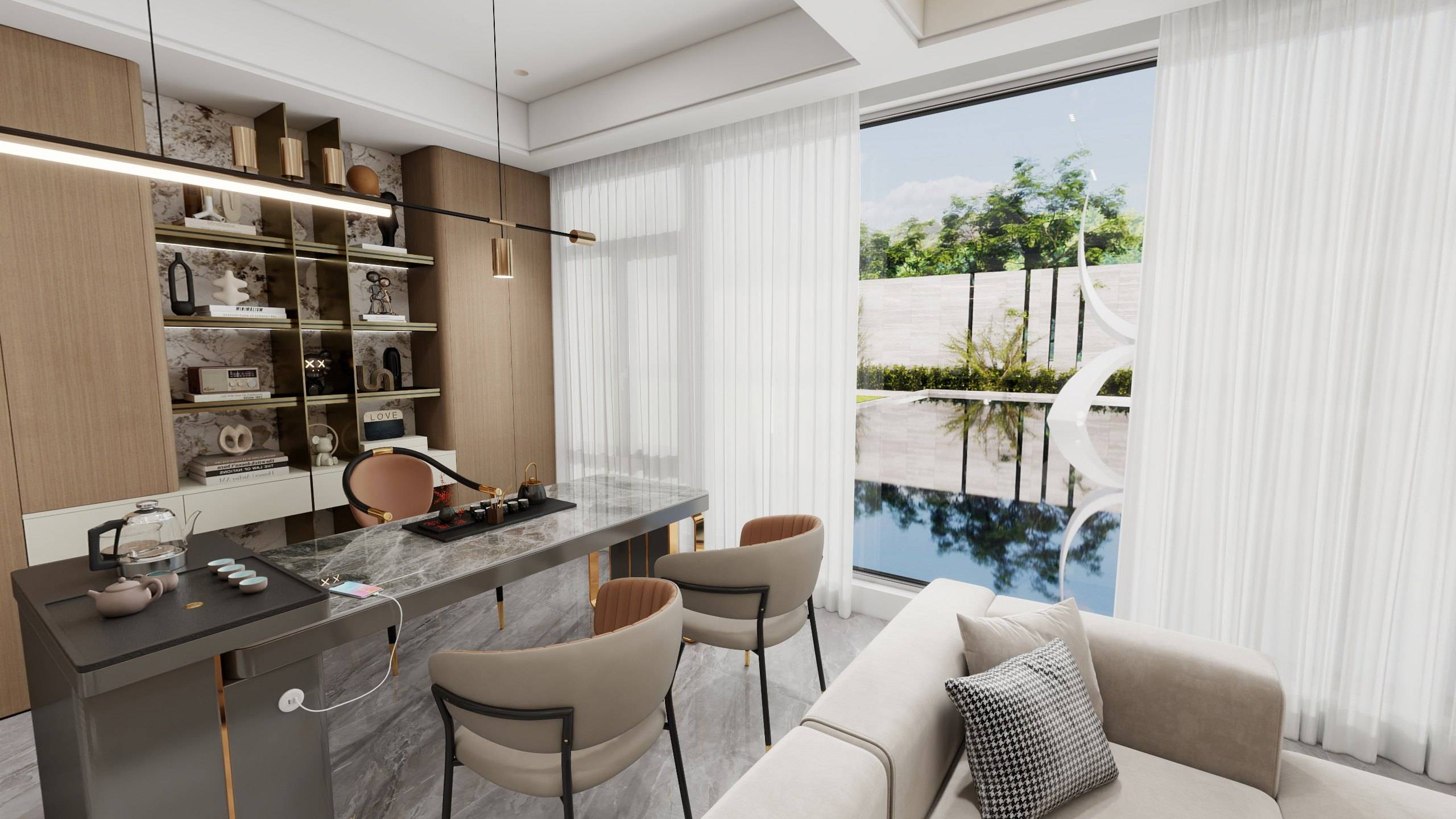
The most common mistake when furnishing a home is to start with objects: a sofa seen in a showroom, a table admired online. The most reliable way is to start with the space and work towards the objects.
1. Gather the plan
Everything starts with an accurate floor plan: room dimensions, window and door positions, ceiling heights, and the location of power and lighting points. If you do not have one, a measured survey is worth commissioning. Our guide on reading a floor plan explains what to look for.
2. Understand how you live
Who lives in the home, and how? Do you entertain large groups or small ones? Does anyone work from home? Are there elderly relatives or young children? What do you need to store? The answers shape every room.
3. Define a palette
Choose a small family of materials — perhaps two timbers, a stone, a metal and a set of textiles — and carry them through the home. The Garden Residence uses dark and pale timbers, veined stone, cognac leather and bronze-toned metal on every floor.
4. Draw a furniture plan
Place every piece on the plan at its real size: sofas, tables, beds, wardrobes, rugs, lamps. Check circulation and sightlines. This is where most problems are solved, cheaply, on paper.
5. Decide what is custom and what is selected
Built-in storage and pieces that must fit precisely are best made to measure; others can be selected. See custom vs ready-made furniture.
6. Specify and sample
Produce a schedule of every item with dimensions, materials and finishes, and review physical samples together under your home’s light.
7. Produce and deliver in sequence
Coordinate production so that pieces arrive in a sensible order — cabinetry first, then large furniture, then lighting, textiles and styling.
Common mistakes to avoid
- Buying the largest pieces first, before the plan is drawn — and discovering they do not fit.
- Choosing every room separately, so the home feels like a series of different shops.
- Leaving storage until last, when it should be designed into the walls from the start.
- Forgetting lighting, which changes how every material and colour is perceived.
- Underestimating delivery: lift sizes, stair turns and building rules all affect what can arrive.
Most of these are avoided simply by working in the order above — plan, palette, layout, specification, then production — and by treating the home as one project rather than a collection of rooms.
This is the process behind our whole-home furnishing service. When you are ready, tell us about your space.
Continue reading
Tell us about your space.
Share your floor plan, room photographs and what you hope to create.