Furnishing a Holiday Home Remotely
A holiday home furnished from far away can feel as considered as one furnished next door, if the distance is planned for. Measurements, materials, delivery and handover all need a clear process and a trusted person on site.
Furnishing a home you are not able to visit often is a planning problem before it is a design problem. The room may be measured, the sofa chosen and the delivery booked, yet it still depends on whether someone local can receive the goods, check the dimensions, and resolve the small issues that always appear on arrival. A holiday home furnished remotely works well when the design is decided with the distance in mind, the local coordination is set up early, and the materials are chosen to cope with a house that may be empty for weeks at a time.
This guide sets out how we approach a remote project within whole-home furnishing: defining the home's role, measuring and approving at a distance, choosing durable materials, and managing delivery and handover.
Decide what the home is for
A holiday home has different needs from a permanent residence. Is it used by the owners for a few weeks each year, or is it let to guests? Is it a base for family gatherings, or a quiet retreat for one or two people? How often will it be cleaned, and who will do it? These answers shape the design. A home that is let frequently needs robust surfaces, easy cleaning, simple fittings and spares that can be replaced quickly. A home used mainly by the owners may allow more delicate or personal pieces, provided they are protected when the house is empty.
- Write down the typical number of guests and the longest period the home is empty.
- Decide which rooms matter most, and which can be furnished more simply at first.
- Agree whether guests will use the home, and what they are likely to handle, spill or move.
- Confirm whether any existing furniture, art or fittings will remain.
Measure through trusted local hands
The biggest risk in remote furnishing is dimensions. A photograph and an estimate are not enough for built-in joinery, a dining table or a bed. Arrange for a trusted person on site to measure every room, doorway, window and staircase, with a laser measure and a clear sketch. Ask them to record the height of ceilings, the position of sockets and radiators, the swing of doors and any steps or thresholds that will affect delivery. Photographs of each wall, taken square-on and at a consistent height, are invaluable for design decisions and for checking fit later.
Measure the home again if it has been altered since the last visit. A kitchen refitted, a wall removed or a new bathroom changes the routes through the house. It is better to confirm a dimension with a second set of measurements than to discover a mistake on the day of installation.
Approve samples and finishes without a visit
Colour and texture are hard to judge through a screen. The colour of a fabric or timber changes under local daylight, and a sample that looked warm in one room can look grey in another. Where possible, order physical samples and have them viewed in the home, in daylight and in the evening, and photograph them alongside the surfaces they will sit against. Video calls can help when someone local shows the room in real time. Three-dimensional visualisations are useful for layout and proportion, but they are not a substitute for a sample in the room.
Agree a simple approval process: which decisions need your sign-off, which can be made by your designer, and how quickly a response is needed to keep the programme on track. A shared document with the schedule, drawings and approvals avoids the confusion of multiple messages across time zones.
Choose materials for an empty house
A holiday home is often exposed to conditions that a permanent home is not. It may be empty for long periods, which means little air movement, and it may face heat, cold, damp or salt air depending on its location. Solid timber responds to humidity and must be allowed to acclimatise, and it should be finished with a protection suited to the climate. Upholstery should be durable and easy to clean, and cushions and throws are best kept in a dry, ventilated place when the house is closed. Stone and tiles handle humidity well, but grout, sealers and metal fittings need checking for corrosion in coastal settings.
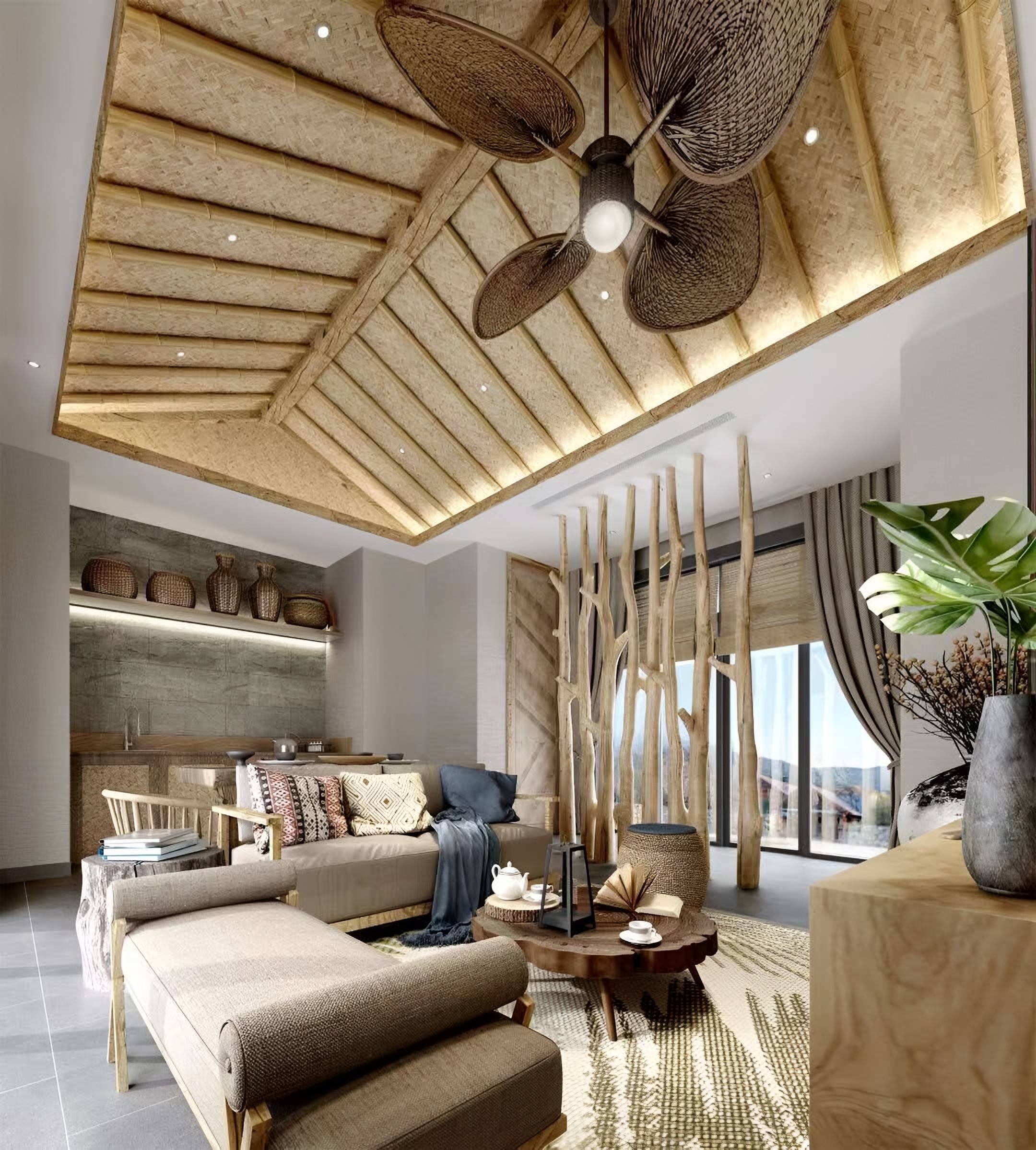
The Bamboo and Timber Mountain Retreat shows how natural materials, such as timber, bamboo and stone, can create a warm interior that suits a retreat. The same principles apply in a holiday home: choose materials that age well, and avoid finishes that need frequent attention.
Electrical, safety and local standards
Electrical supplies, plug types and safety requirements vary between countries and sometimes between buildings. Check the local voltage and plug type before any electrical appliance is specified, and make sure that lighting, sockets and any integrated joinery lighting are installed by a qualified local electrician in line with local rules. Smoke and carbon monoxide detection and fire safety requirements also differ, and a local professional should confirm what is needed for the home and for any guest use.
Delivery, customs and installation
International delivery involves packing, freight, customs clearance and local transport. Each stage has its own timing and paperwork, and each can cause delay if it is not coordinated. Ask for a delivery plan that shows the routing, the expected stages and who is responsible for each. Large pieces may need to be delivered in sections, and the local route, lift and staircase must be confirmed in advance. Where installation is needed, it can be coordinated with qualified local partners where available; the scope and responsibilities should be agreed in writing.
Make sure the home is ready to receive the goods. The building should be dry, the floors protected, the access arranged and someone available to sign for deliveries and check items on arrival. Keep a record of each item's condition when it is unpacked, and report any damage promptly so that it can be assessed and resolved.
Handover and aftercare
A remote project should end with a clear handover. This includes a schedule of every item, its finish and quantity, the care instructions for each material, and any spares or documentation for appliances and fittings. Keep a copy of the drawings and the room layouts with the home's records, so that future repairs or replacements can be matched accurately. Agree how questions after handover will be handled, and who will contact whom if something needs attention.
A checklist for furnishing from a distance
- Defined the home's role and how often it will be empty or let.
- Had every room, doorway and staircase measured by a trusted local person.
- Viewed physical samples in the home, in daylight and in the evening.
- Chosen materials that cope with humidity, temperature and periods of no occupancy.
- Checked local electrical, plug and safety requirements before specifying.
- Agreed the delivery route, customs responsibilities and installation scope in writing.
- Arranged someone on site to receive, check and report on each delivery.
Furnishing a home from afar is entirely practical when the process is clear. If you have a holiday home to furnish, start a project with the plans, photographs and measurements you have, and a note of how the home will be used. We can plan the design, coordinate the delivery and set up the handover so that the home is ready when you arrive, as part of our whole-home furnishing service.
Continue reading
Tell us about your space.
Share your floor plan, room photographs and what you hope to create.