Kitchen Cabinetry Materials Compared
Cabinet fronts are the most handled surfaces in a kitchen. The material you choose decides how the room looks on the first day and how it looks after ten years of cooking.
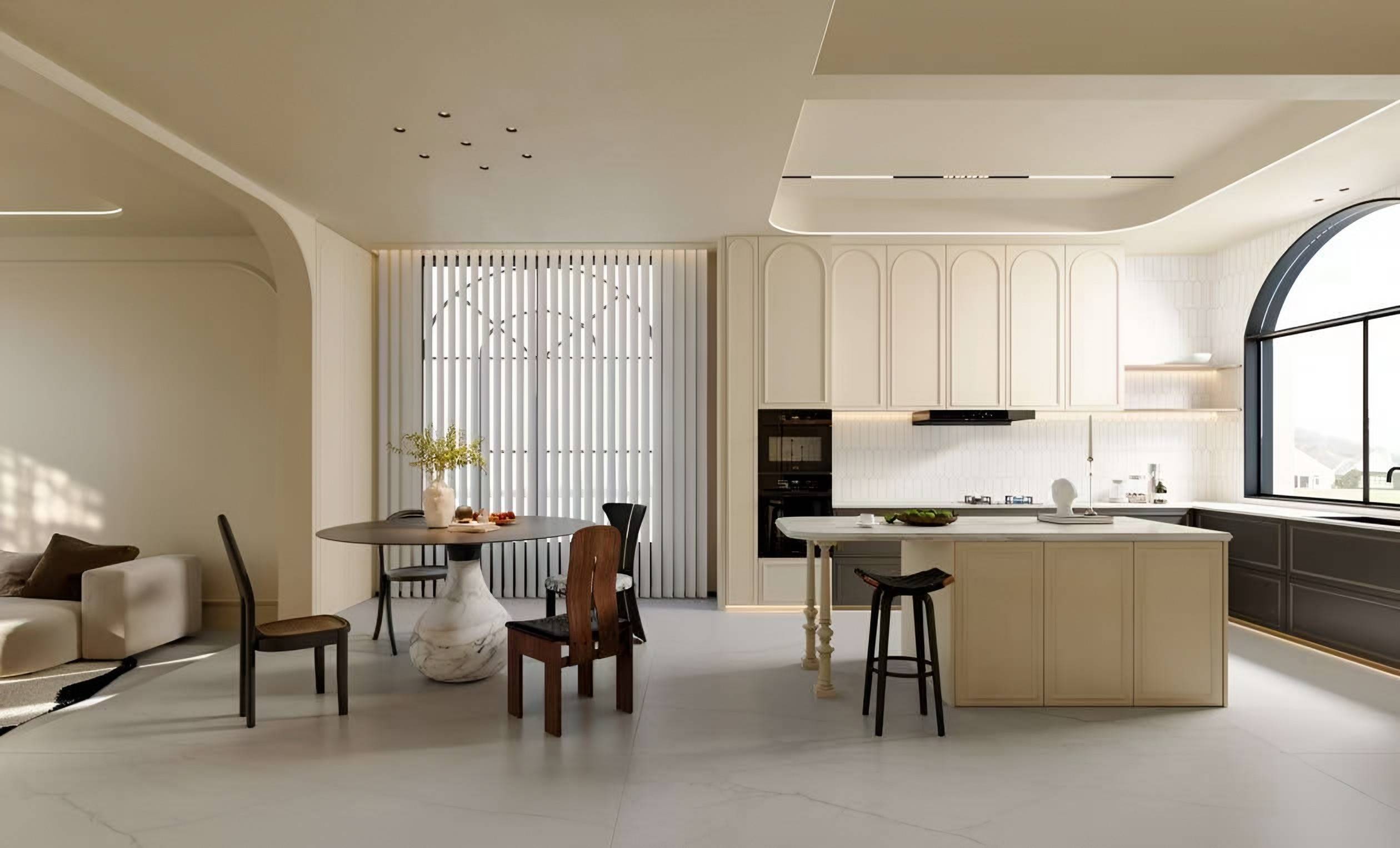
The right kitchen cabinetry material depends on how you cook, how often you clean, how much light the room receives and how you want it to age. Lacquer gives a smooth, even colour; wood veneer and solid timber bring grain and warmth; stone fronts are rare and dramatic. None is universally better. Each behaves differently in use, and the most successful kitchens choose their materials for those behaviours, not only for the photograph.
This guide compares the four families of finish we most often discuss when designing custom cabinetry for kitchens, and explains what to weigh before choosing.
Start with how the kitchen is used
Before comparing finishes, be specific about the kitchen's job. Is it a working kitchen where pans are washed and surfaces wiped several times a day? Is it a show kitchen that is cooked in on weekends? Does it receive strong direct sunlight, which can fade some timbers and make others look warmer? Are there children or pets who will test the lower doors? Answering these questions narrows the field quickly.
- Cooking frequency and typical splashes, steam and grease near the hob.
- Daylight: the direction the kitchen faces, and whether colour will be judged mostly by daylight or lamplight.
- Who cleans it, and how much time they are prepared to spend on it.
- Whether the cabinetry is meant to disappear into the wall or to be a feature in its own right.
Lacquer: smooth, even and precise
Lacquered fronts are applied in multiple coats and then finished to a smooth, uniform surface. The effect is calm and contemporary, and it suits flush, handle-less doors where a clean line matters more than texture. Lacquer can be produced in a wide range of colours, including soft whites, warm taupes and deep neutrals, and it photographs and reflects light consistently.
The trade-offs are visibility and repair. A glossy lacquer shows fingerprints and fine scratches more readily than a textured surface, and a matt finish hides them better but can feel less crisp. Lacquer also depends on careful preparation: a poorly prepared substrate or a rushed coat will show. Repairs are possible, but matching a colour exactly across a run of doors takes skill, so it is worth keeping a spare sample from the original batch.
Wood veneer: grain without the weight
Veneer is a thin slice of real timber bonded to a stable core. It allows designers to use a rare or richly figured wood across large areas, with the grain matched across doors and panels so that the run reads as one surface. Oak veneer is calm and fairly neutral; walnut veneer is darker and more figured. Because the core is stable, veneered panels tend to move less than solid boards, which matters for long runs of doors.
The trade-off is that the surface is a thin layer. It can be sanded and refinished only a limited number of times, and damage through to the core is difficult to hide. Quality depends on the veneer's thickness, the way sheets are matched and the finish applied over them. A good maker will show you matched panels and explain how the grain will run across each door and drawer.
Solid timber: the most honest choice
Solid timber fronts are made from boards glued together and shaped, with the grain running through the whole thickness. They have depth, variation and a tactile quality that veneer cannot quite match, and they age in a visible way. Pale oak darkens slightly over time; walnut tends to deepen; many timbers develop a softer patina where hands and cloths touch them most.
Solid timber moves with humidity, so cabinetry must be designed to allow for seasonal expansion and contraction, particularly on wide panels and long runs. Joins, grain direction and the choice of finish all matter. Oiled or waxed finishes feel the most natural but need periodic maintenance; a sealed or lacquered finish is more protective and easier to clean, but it hides some of the timber's character. Ask which finish is proposed and why.
Stone fronts: rare and demanding
Stone fronts, usually in thin cut slabs, are used sparingly in kitchens. They create a dramatic, almost sculptural effect, particularly with veined marble or stone that is book-matched across a run of doors. Stone is heavy and unforgiving: it needs careful structural support, precise cutting and fitting, and handling that avoids chips at the edges.
Most stone surfaces are porous to some degree, so they need appropriate sealing and quick cleaning of acidic spills such as citrus or wine. Some stones are more resilient than others, and the finish, whether polished, honed or leathered, changes both the look and how easily it marks. Stone fronts are best considered for a limited area, such as an island end, a tall column or a feature wall, rather than the whole kitchen.
Mixing materials
Few kitchens use one material everywhere. A common and successful approach is to keep the main run in a calm, durable finish such as lacquer or veneer, and to use solid timber or stone for a single element: an island, a tall pantry, or the frame around a window. Keep the number of materials small, and let the grain, colour and sheen of each relate to the others. The cream arched kitchen in the Cream Arched Residence shows how one soft finish can carry through arched doors, an island and a stone-pedestal table without competing.
Where cabinetry meets the worktop, the splashback and the flooring, check that the colours and undertones sit together under both daylight and artificial light. A sample board in the room is more reliable than a screen.
Edges, handles and hardware
The edges of a door are where wear shows first. Thin, crisp edges look refined but chip more easily than softened ones. Handle-less fronts depend on precise shadow gaps and reliable opening mechanisms; handles add a visual point of contact but also add cleaning points. Hinges and drawer runners should be specified with the material in mind, since heavier stone or thick timber fronts need stronger hardware.
Questions to ask a maker
- Which finish is proposed for each element, and what is the expected maintenance?
- How will the grain or veining run across doors and drawers, and can you show matched samples?
- How are colours and sheens checked, and will the finish match a sample under daylight and lamplight?
- How does the design allow for timber movement or for the weight of stone?
- What is the repair approach if a panel is damaged, and is a spare batch kept?
- Who fits the cabinetry, and how is it coordinated with the worktops and appliances?
A practical checklist
- Decide the kitchen's daily use before choosing a finish.
- Test samples in your own light, morning and evening.
- Choose a single feature material if you want richness without the cost and care of using it everywhere.
- Plan the edges and handles as carefully as the colour.
- Keep a spare sample or offcut for future repairs.
If you are planning a kitchen, start a project with a floor plan, photographs of the room at different times of day, and a note of how you cook. We can recommend materials that suit your routine and design the cabinetry to match, as part of a wider custom furniture plan for the home.
Continue reading
Tell us about your space.
Share your floor plan, room photographs and what you hope to create.